
Build Diary
- Details
- Written by: Gordon
- Category: Build Diary
- Hits: 10
Revisit fitting headlight pods, indicator stalk boss and dash layout.
- Details
- Written by: Gordon
- Category: Build Diary
- Hits: 13
To fit the seats and seat belts we need to drill some holes in the floor pan. The build manual comes with a number of diagrams showing the location of the holes for various gearshift configurations. I have the G50 with right hand rod shifter.

The holes are referenced to edges of the floor pan, but with the lowered floor this becomes a bit of a challenge as the reference points to measure from are on the edges of the un-lowered section. To add to the challenge the seats are located at a slight angle so the holes do not run parallel with the reference edges of the floor pan. The holes in the runners are 12" apart and the runners are located 350mm apart.
If the holes are not reasonably accurately located then apart from the obvious difficulty of inserting all of the seat runner bolts,there may be binding when moving the seats on the runners.
To assist in locating I use an engineers square along with a steel rule.


As a final check I also measure between the holes and verify the 12" and 350mm dimensions, I also measure diagonally between the holes on the seat runners when fitted to the seats and compare with my markings on the floor pan.
With the seats installed I find that when I seated I have trouble reaching the pedals even with the seat fully moved forward.
Closer examination reveals that the seat movement forward is restricted by the front edge of the lowered floor pan.
To overcome this I need to raise the seat to allow the runners to clear the lowered floor pan lip.
I decide to fabricate some box section steel to elevate the seats by the required amount.


I felt that if I just drilled clearance holes and installed longer bolts to secure the seats then there was a chance of the box section collapsing over time allowing the bolts to become loose or overtighting of the bolts could equally begin to collapse the section. To satisfy myself I machine some steel inserts to slide into the box section.


The blocks are drilled and tapped and then when located in the steel box section are tacked in with a couple of beads of weld. Once completed the risers are given a quick coat of black paint and fitted to the driver seat with some button head screws that screw down through the rails and into the blocks, care was taken to ensure that the length of the screws was such that they did not extend more than half way into the blocks - we need threads on the other side to screw the completed runners to the floor pan from underneath.


There is no need to raise the passenger seat so to make the fitting easier some nuts were tacked to the runners and repainted.


Both seats were then fitted using some more button head screws through the floor pan from underneath, although they will have to be removed to fit the carpet.
- Details
- Written by: Gordon
- Category: Build Diary
- Hits: 12
The gear linkage needs to be drilled and pinned in a number of places.
My drill press is on a shelf which is a bit too high for my short legs I do need to sort this out although I kind of want an older floor standing pillar drill. Consequently I am never confident in drilling accurately located holes - particularly in a round object such as a shaft.
I decide to use the vertical slide on the lathe with a drill chuck in the head stock.
I install the components in the car and once happy I mark the shaft alignments and hole locations.
I make some copper shims from a piece of plumbing pipe to align the universal joints in the vice. Holes are started with a centre drill and then drilled through with a standard 5/32" drill bit. To enable easier insertion of the pins I use a centre drill to break the edge of the hole and provide a slight lead in.
This is repeated for all of the require holes.


- Details
- Written by: Gordon
- Category: Build Diary
- Hits: 9
I make some measurements and get a reasonable idea of how long I need to have the steering column extended but it is a bit hit and miss and I need to be sure.
I decide that I will lengthen my column and once I get the length I can order the correct length one from the factory.
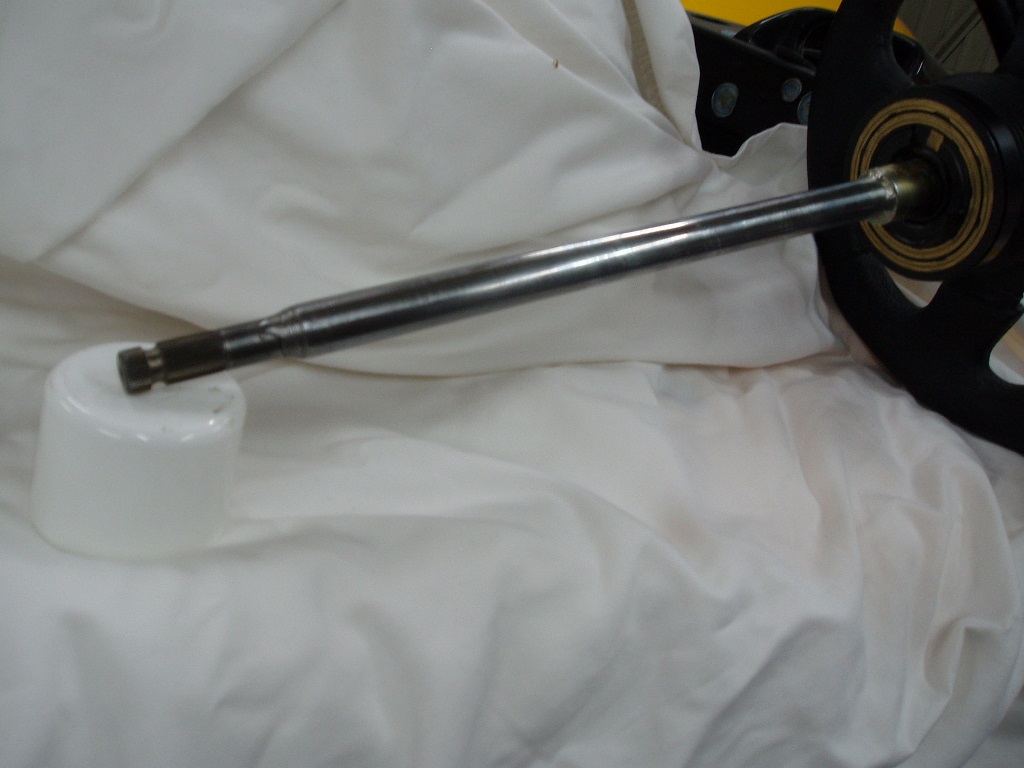
Examining the shaft the bottom spline appears to be a section welded in to a tube with the boss welded on to the top end.
I figure that I should be able to remove the spline and insert a longer one.
Measuring the short piece of shaft by the spline it seems to be 14mm
I order a section of 14mm (9/16") diameter x 36 spline shaft from Car Builder Solutions and set to work.
I mount the column in the 4 jaw chuck of the lathe and centre it up.I support the end near the spline with a fixed steady and carefully turn down the welding.
Unfortunately I did not take any photos until I had completed it.


The replacement shaft is a slightly to large to fit in the column and so I turn it down to fit.

Being a sliding fit in the column I can now install it and mark on the splined shaft where it enters the column.
I run a bead of weld securing the spline in the column and test fit it to the car.
- Details
- Written by: Gordon
- Category: Build Diary
- Hits: 11
Work on the steering column length, fit the gear change linkage and seats with riser blocks.